Energy Security & Economic Resilience in Asia
Resilienceapac – Asia today stands at an energy crossroads. The region is growing faster than any other global economic bloc, building new cities, powering new industries, and lifting millions into the middle class. Every rising apartment tower, new industrial zone, and smart transportation network relies on reliable and affordable energy. Yet behind this progress lies a fragile reality: securing energy supply while protecting economic strength is becoming the defining challenge of this era. From fuel shortages and geopolitical shocks to climate risks and technology disruption, energy security in asia determines whether nations can protect livelihoods and continue building strong, future-ready economies.
The stakes feel personal when viewed through human stories, not just policy papers. Picture a manufacturing worker in Vietnam whose plant pauses production because global fuel prices spike. Imagine a fisherman in the Philippines unable to afford generator fuel after a storm disrupts supply routes. Visualize an Indonesian student studying by candlelight during planned power rationing in a remote district. These moments remind us that resilience is not abstract it lives in the everyday experiences of families, workers, and communities. Therefore, efforts to improve energy security in asia are not only about grids and oil reserves; they are about economic dignity, opportunity, and long-term stability across the region.
Asia’s rapid development has transformed the global energy map, yet the region remains heavily dependent on imported fuels, exposed to price volatility, and vulnerable to supply disruptions. At the same time, climate change demands cleaner solutions, while digitalization increases demand for stable power networks. The intersection of growth, sustainability, and security means policymakers, private investors, and communities all share responsibility. As a result, discussions about energy security in asia now include renewable investments, cross-border power trading, climate adaptation, and innovation in green finance. This shift marks a new era one where infrastructure and policy must evolve together to protect both the present and the future.
Read More : Theatre Comedy for the TikTok Generation
Asia consumes more energy than any other region. However, demand continues rising faster than supply diversification. Nations depend on imported oil and gas while also racing to build renewable capacity. This dual pressure shapes energy security in asia, forcing governments to secure stable fuel imports while investing in domestic energy independence.
Japan, South Korea, India, and many ASEAN countries rely heavily on overseas energy. When global shipping lanes face disruption or oil prices surge, supply chains weaken. Thus, reducing import dependence becomes critical for energy security in asia and long-term cost stability.
Solar, wind, geothermal, and hydro power are growing rapidly across emerging economies. Yet integrating large renewable capacity requires advanced grid stability and storage investment. Governments prioritize clean energy not only for climate goals, but because renewables strengthen energy security in asia and reduce exposure to price shocks.
Cross-border electricity grids, LNG trading hubs, and shared energy reserves allow countries to support one another in emergencies. This cooperation model strengthens energy security in asia by distributing risk and optimizing resource allocation.
Key initiatives include:
ASEAN Power Grid
South Asia Regional Energy Strategy
Cross-border LNG infrastructure
Strategic fuel storage partnerships
To reinforce energy security in asia, nations invest in multiple sources:
Natural gas expansion
Hydrogen development hubs
Nuclear technology modernization
Biofuel innovation
Offshore wind corridors
Diversification protects economies from sudden shocks and supports industrial growth.
As energy systems digitize, power grids become vulnerable to cyberattacks. Securing data, SCADA systems, and AI-driven energy platforms is now essential. Cyber defense therefore becomes a building block of energy security in asia, ensuring uninterrupted operations and safety.
Local power solutions reduce strain on national grids and empower rural regions. Community solar farms, micro-hydro plants, and battery banks support remote villages. These systems create social equity and support energy security in asia from the ground up, where resilience matters most.
Example benefit clusters:
Rural electrification
Local industry development
Energy access equity
Disaster-resilient power
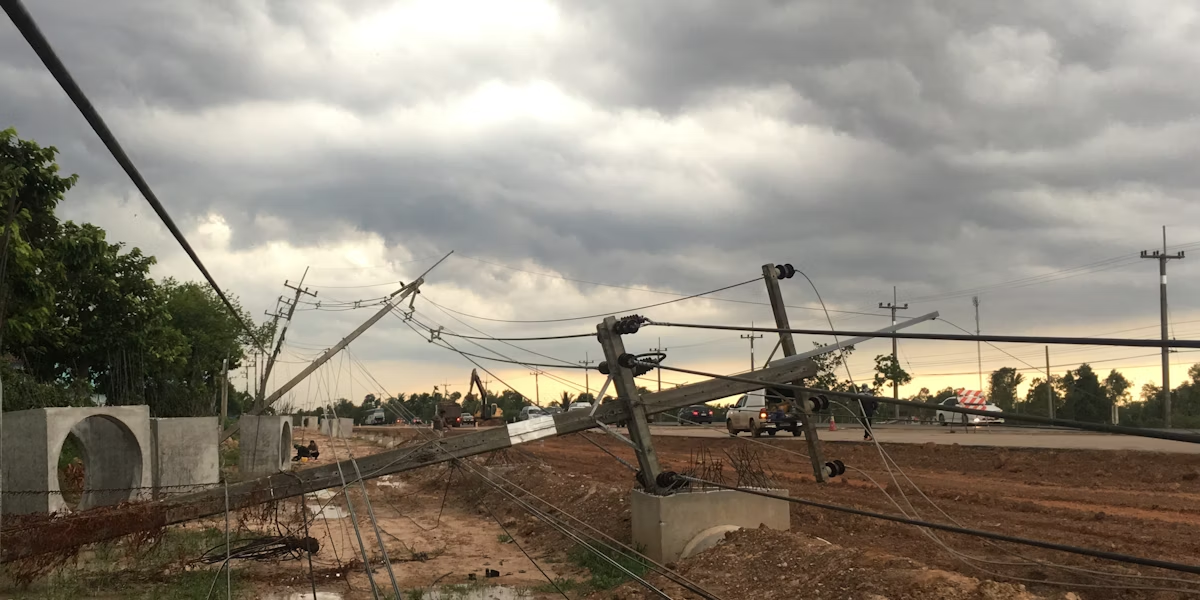
Typhoons, heatwaves, and floods frequently disrupt supply lines. Therefore, climate-proof energy infrastructure elevated substations, smart flood-resistant grids, protected LNG terminals — becomes critical to energy security in asia. Nations cannot afford fragile systems in a volatile climate.
Public incentives, carbon markets, blended finance, and sovereign green bonds accelerate energy transition. Strong financial frameworks boost investor confidence and strengthen energy security in asia while advancing sustainable growth.
Energy transition requires skilled engineers, digital technicians, rural energy workers, and climate-literate policymakers. Workforce development programs ensure that energy security in asia is backed by human capital, not only technology.
In the end, the region’s future depends on choices made today whether leaders prioritize long-term resilience over short-term convenience, whether households receive stable energy access, and whether industries evolve before disruptions force change. When communities, governments, and companies collaborate, they build systems that protect progress, not just power grids. That shared effort ultimately defines energy security in asia as more than supply lines it becomes the foundation of shared prosperity, innovation, and economic dignity across an increasingly interconnected region.
Resilienceapac - Across the Asia-Pacific region, community-driven resilience programs have reduced disaster recovery time by 47% in pilot districts between…
Resilienceapac - A recent comprehensive analysis indicates that over 400 million people across the Asia Pacific region still lack access…
Resilienceapac - The Asia-Pacific region stands on the precipice of an irreversible climate breakdown, having experienced a staggering 60 percent…
Resilienceapac - In 2023 alone, the Asia-Pacific region accounted for more than 40 percent of global natural disaster events, resulting…
Resilienceapac - The Asian Development Bank estimates the region suffered a staggering $3.5 trillion economic loss between 2020 and 2022,…
Resilienceapac - Recent data from the United Nations Economic and Social Commission for Asia and the Pacific (UNESCAP) indicates the…

